Jaipur is one of the famous cities of Rajasthan located in the northern part of India. Jaipur being the capital city is considered as the first planned metropolitan are in Rajasthan. During the British rule, Rajasthan was known as the State of Jaipur, where Jaipur was the capital founded by Maharaja Sawai Jai Singh II. Currently, Jaipur is prominently known as the Pink City because it incorporates buildings painted in pink. The grand royal structure of Jaipur offers the visitors a rich taste of Rajputs and Royal families. Today this place is considered as one of the main business centers and tourist destinations equipped with all amenities of a metropolitan area.
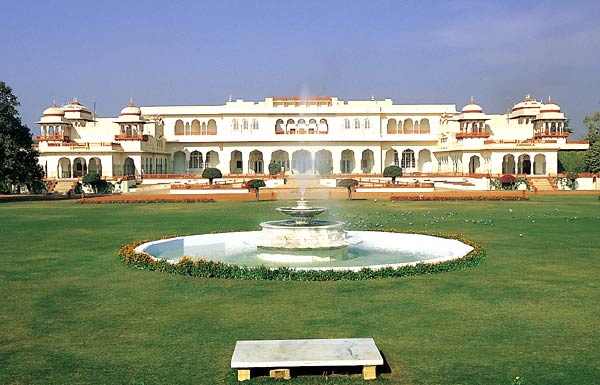 People who love to wish palaces, this place will surely leave them with a great experience. Here vacationers come from different parts of the world and learn about different royal families and their life styles. Some of the famous tourist spots include Hawa Mahal, Nahargarh Fort (Residence of King Sawai Jai Singh II) and the famous Jantar Mantar.
Climate
Located in the deserts of Rajasthan, Jaipur is usually hot throughout the year with temperature reaching up to 40 degree centigrade during the summers. The city becomes pleasant, during the winter season when temperature ranges from 15 degree centigrade to 20 degree centigrade. In rainy season, the city receives heavy rainfall accompanied with thunder storms and strong winds. The winters bring in a change of cold wind waves that hit the city with a temperature which even drops to freezing point.
Places of Interest
Jaipur has a rich royal heritage and so it is well known for its marvelous palaces, gardens and forts. The untouched beauty of this place attracts huge tourists throughout the year. People visit the marvelous structures, grand palaces, lakes and gardens to experience the glory of the royal families in the past and their style of living. Some of the major tourist spots include:
- Gardens: Zoological Garden, Ram Niwas Garden, Vidhyadhar Garden, Central Park, Sisodia Rani Palace Garden, Kanak Vrindavan and Smriti Van.
- Palaces, Forts and Monuments: Rambagh Palace, Hawa Mahal, Amber Fort, City Palace, Jal Mahal, Jantar Mantar, Jaighar Fort, Chandra Mahal, Diwan-e-Aam and Naharghar Fort to name a few.
- Temples: Birla Temple (Lakshmi Narayana Temple), Galtaji, Govinda Devi Ji Temple, Jain Temple, Sri Krishna Pranami Mandir and lots more.
Amber Fort
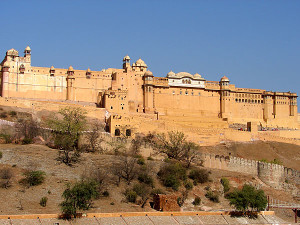 Amber Fort is the first on the list of many tourists on a sightseeing tour of the major tourist attractions in Jaipur. Set on a hilltop on the outskirts of Jaipur, it too nearly 2 centuries to complete this fort. Built by Raja Man Singh in the 16th century and completed by Sawai Jai Singh in the 18th century, the Amber Fort has several sites worth a visit.
 Amber Fort is the first on the list of many tourists on a sightseeing tour of the major tourist attractions in Jaipur. Set on a hilltop on the outskirts of Jaipur, it too nearly 2 centuries to complete this fort. Built by Raja Man Singh in the 16th century and completed by Sawai Jai Singh in the 18th century, the Amber Fort has several sites worth a visit.
The City Palace Jaipur
 The City Palace was built by Maharaja Jai Singh II of the Kachhwaha clan of Rajputs, but a lot of changes and additions were made to the original structure by his successors. The architecture of the City Palace is a synthesis of Rajasthani and Mughal styles. The Complex comprises of many structures, courtyards, gardens and buildings. There are many splendid small palaces and halls in the complex, such as the Chandra Mahal, Mubarak Mahal and Badal Mahal. There is also a famous temple called the Shri Govind Temple and a museum inside, named the City Palace Museum. As one enters the first courtyard, one comes across the Mubarak Mahal, which was built in the 19th century by Maharaja Madho Singh II. Here is a splendid gateway, which leads to the Diwan-I-Khas (Hall of Private audience). It is an open hall, where there are two silver vessels on display, which are in the Guinness book of World Records! One can also check out the Diwan-I-Aam (Hall of Public Audience).
 The City Palace was built by Maharaja Jai Singh II of the Kachhwaha clan of Rajputs, but a lot of changes and additions were made to the original structure by his successors. The architecture of the City Palace is a synthesis of Rajasthani and Mughal styles. The Complex comprises of many structures, courtyards, gardens and buildings. There are many splendid small palaces and halls in the complex, such as the Chandra Mahal, Mubarak Mahal and Badal Mahal. There is also a famous temple called the Shri Govind Temple and a museum inside, named the City Palace Museum. As one enters the first courtyard, one comes across the Mubarak Mahal, which was built in the 19th century by Maharaja Madho Singh II. Here is a splendid gateway, which leads to the Diwan-I-Khas (Hall of Private audience). It is an open hall, where there are two silver vessels on display, which are in the Guinness book of World Records! One can also check out the Diwan-I-Aam (Hall of Public Audience).
Ram Niwas Bagh:
Ram Niwas Bagh: Built as a famine relief project by Sawai Ram Singh II in 1868 AD, it houses a well-kept spacious garden with a zoo, an aviary, a greenhouse, a herbarium, a museum and a sport ground.
Ram Niwas Bagh: Built as a famine relief project by Sawai Ram Singh II in 1868 AD, it houses a well-kept spacious garden with a zoo, an aviary, a greenhouse, a herbarium, a museum and a sport ground.

No comments:
Post a Comment